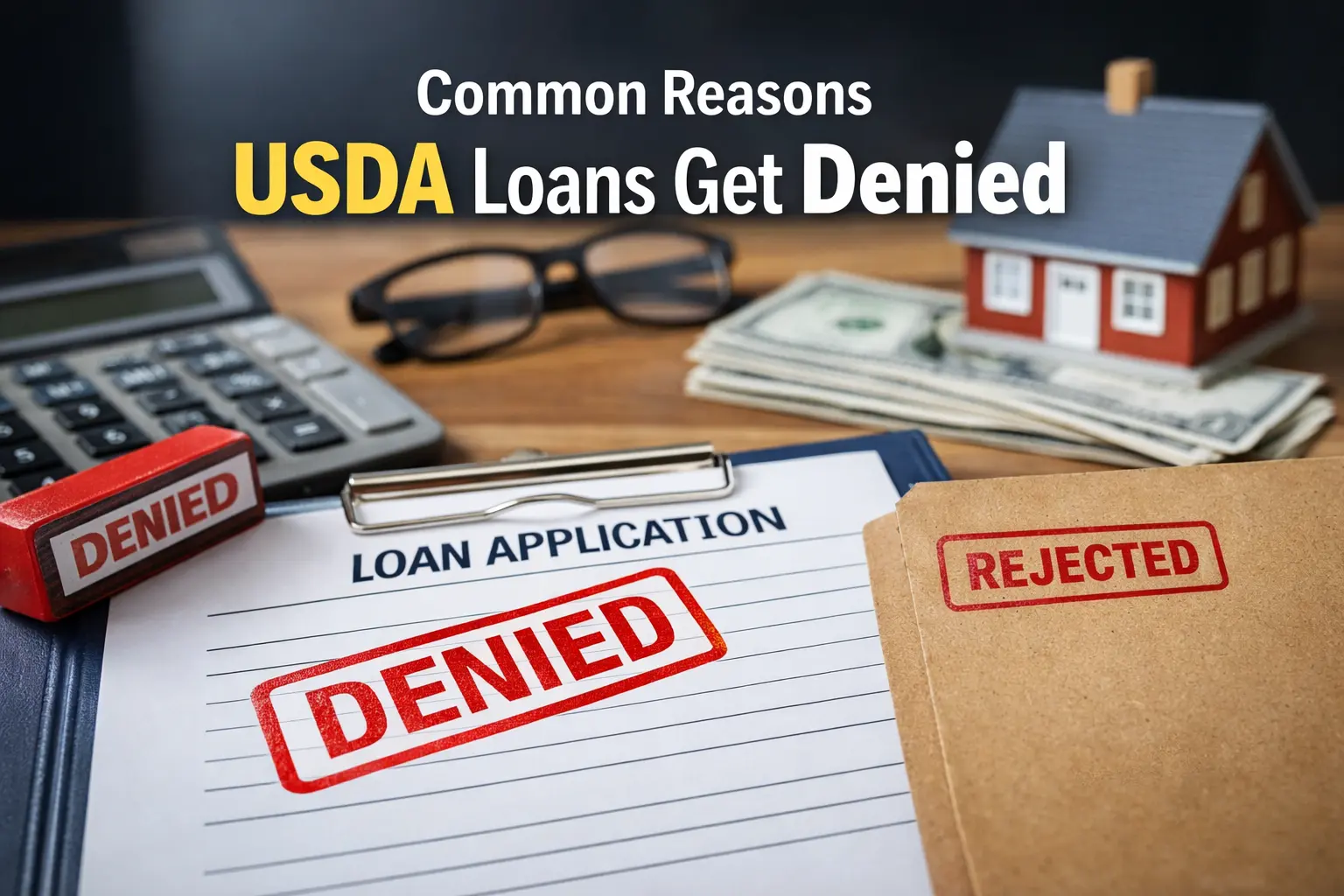
USDA loans help buyers purchase a home with zero down payment. But many applications still get denied.
Understanding the reasons USDA loans get denied can help you avoid mistakes and improve your approval chances.
This guide explains the most common issues and how to fix them.
Why USDA Loans Get Denied
USDA loans follow strict guidelines set by U.S. Department of Agriculture.
Lenders must verify:
- Income
- Credit
- Property eligibility
- Household details
If one area does not meet the rules, the loan can be denied.
Income Is Too High for USDA Limits
USDA loans have income limits based on:
- County
- Household size
If your total household income exceeds the limit, the loan may be denied.
Common mistakes:
- Forgetting to include non-borrowing household income
- Underestimating bonuses or overtime
Tip: Ask a lender to check income limits early.
Not sure if your income qualifies? Get a USDA eligibility review.
Property Is Not in an Eligible Area
USDA loans only work in approved rural areas.
Denials happen when:
- The home is outside the USDA map
- Buyers assume suburban areas qualify
Even a few streets can make a difference.
Check if your home qualifies for a USDA loan before you apply.
Credit Score or Credit History Issues
While USDA loans are flexible, credit still matters.
Common credit-related denials include:
- Low credit score
- Recent late payments
- Collections or charge-offs
- Limited credit history
USDA loans focus on payment patterns, not just the score.
High Debt-to-Income Ratio (DTI)
Your DTI compares:
- Monthly debt
- Monthly income
USDA loans prefer lower DTI levels.
Problems occur when:
- Credit cards carry high balances
- Auto loans increase monthly payments
- New debt appears before closing
Employment or Income Instability
Lenders look for stable income.
Denials can happen if:
- You recently changed jobs
- Income is inconsistent
- Self-employment income is not well documented
Stability is more important than income growth.
Undisclosed Household Members
USDA counts everyone living in the home, even if they are not on the loan.
Denials occur when:
- A household member’s income was not disclosed
- Family members plan to move in later
Transparency is critical.
Property Condition Problems
USDA loans require homes to meet safety and livability standards.
Issues include:
- Structural damage
- Roof problems
- Unsafe utilities
- Major repair needs
Homes must be move-in ready.
Missing or Incorrect Documentation
USDA loans involve extra review steps.
Denials happen due to:
- Missing paperwork
- Inconsistent information
- Late responses to lender requests
Slow communication can stop approvals.
USDA Final Approval Stage Issues
Even after lender approval, USDA performs a final review.
Denials at this stage may happen if:
- New debts appear
- Income changes
- Documents do not match
Final checks are strict.
How to Avoid USDA Loan Denial
Follow these simple rules:
- Verify income limits early
- Check property eligibility first
- Keep credit stable
- Avoid new debt
- Respond quickly to document requests
- Be honest about household income
Preparation makes the difference.
Conclusion
Understanding the reasons USDA loans get denied helps you avoid surprises and delays.
Most denials are preventable with:
- Early planning
- Clear documentation
- Expert guidance
A USDA loan can be a great option when you prepare the right way.
Read More What Documents Lenders Re-Verify Before Closing
FAQs
What is the most common reason USDA loans get denied?
Income exceeding USDA limits is the top reason.
Can a USDA loan be denied after pre-approval?
Yes. Final USDA review can still deny the loan.
Does USDA check household income?
Yes. All household income counts, even non-borrowers.
Can low credit score deny a USDA loan?
Yes, especially with recent late payments or collections.
Can I reapply after USDA loan denial?
Yes. Once issues are fixed, you can reapply.