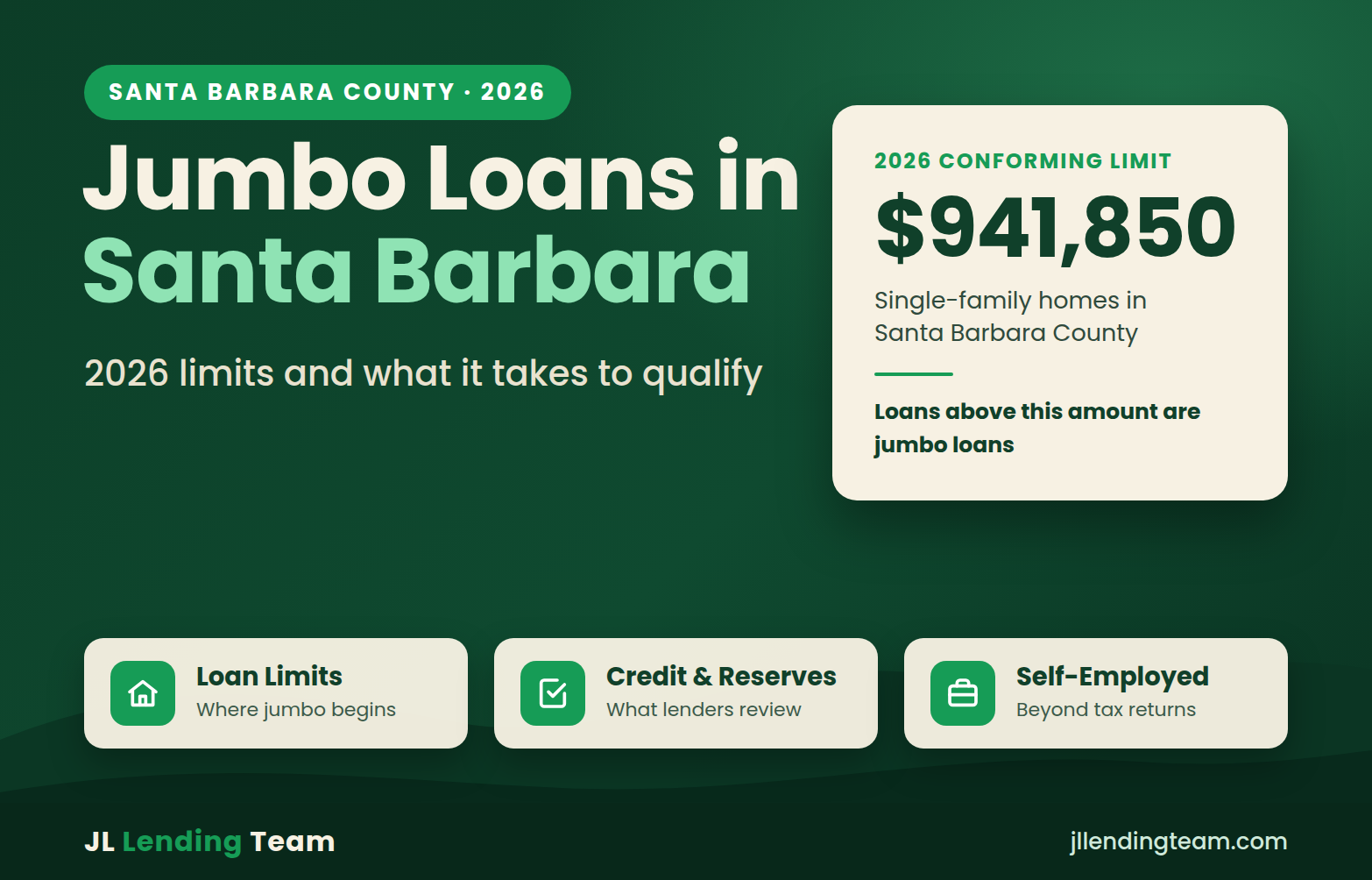
In Santa Barbara County, a jumbo loan is any mortgage above $941,850 for a single-family home in 2026. With the median Santa Barbara home selling for roughly $1.78 million, nearly twice that limit, many local buyers need jumbo financing whether they planned on it or not.
That is the part most people don’t find out until they’re already in escrow. Here’s what a jumbo loan actually requires in this market, and where buyers most often get stuck.
What’s the jumbo loan limit in Santa Barbara?
A jumbo loan is simply a mortgage larger than the conforming loan limit set each year by the Federal Housing Finance Agency. Loans at or below that limit can be sold to Fannie Mae and Freddie Mac. Loans above it can’t, so lenders keep them on their own books or sell them to private investors, which is why the qualifying standards are different.
Santa Barbara County is designated a high-cost area, so our limit sits above the national baseline of $832,750, though below the national ceiling of $1,249,125 that applies in counties like Los Angeles, Orange, and San Francisco.
2026 conforming loan limits: Santa Barbara County
| Property type | Conforming limit | Jumbo territory begins |
|---|---|---|
| 1 unit (single-family) | $941,850 | $941,851+ |
| 2 units | $1,205,750 | $1,205,751+ |
| 3 units | $1,457,450 | $1,457,451+ |
| 4 units | $1,811,300 | $1,811,301+ |
The FHA loan limit in Santa Barbara County is also $941,850 for a single-family home in 2026. VA loans work differently: veterans with full VA entitlement have no county loan limit, though lenders still set their own guidelines.
What’s changing in 2027?
The Federal Housing Finance Agency announces the official 2027 conforming loan limits in late November. Until then, Santa Barbara County’s 2026 limit of $941,850 applies.
Some lenders aren’t waiting. In September 2026, several large lenders began allowing higher conforming limits early, with national baseline figures around $845,000 to $850,000. Because Santa Barbara is a high-cost county, its limit is calculated separately, so the county’s official 2027 figure won’t be known until FHFA’s announcement.
Early limits vary by lender and come with their own eligibility and closing-date rules. Because I work with a wide range of lenders, if your loan amount sits near the line, I can check which lenders’ current limits your loan fits under. We’ll update this page with Santa Barbara County’s official 2027 limits as soon as they’re announced.
Why Santa Barbara buyers need jumbo loans
The math here is unusual even by California standards. According to Redfin, Santa Barbara’s median sale price was $1,780,821 as of August 2026, up 2.1% year over year, with a median of 42 days on market.
Put those two numbers side by side and the picture is clear:
- Median home price: $1,780,821
- Conforming limit: $941,850
- The median home costs: nearly twice the conforming limit
In Montecito, Hope Ranch, and the Riviera, the gap is wider still. Even in Goleta and Carpinteria, where prices run below the city median, many purchases still land above the conforming line.
This is not a luxury-buyer issue. It’s a Santa Barbara issue.
What do lenders look for on a jumbo loan?
Jumbo guidelines are set by individual lenders and private investors rather than by Fannie Mae and Freddie Mac, so they vary more than conventional guidelines do. That variation is the whole reason shopping your loan matters here: one lender’s automatic decline is another lender’s approved file.
That said, most jumbo programs are looking at the same five things:
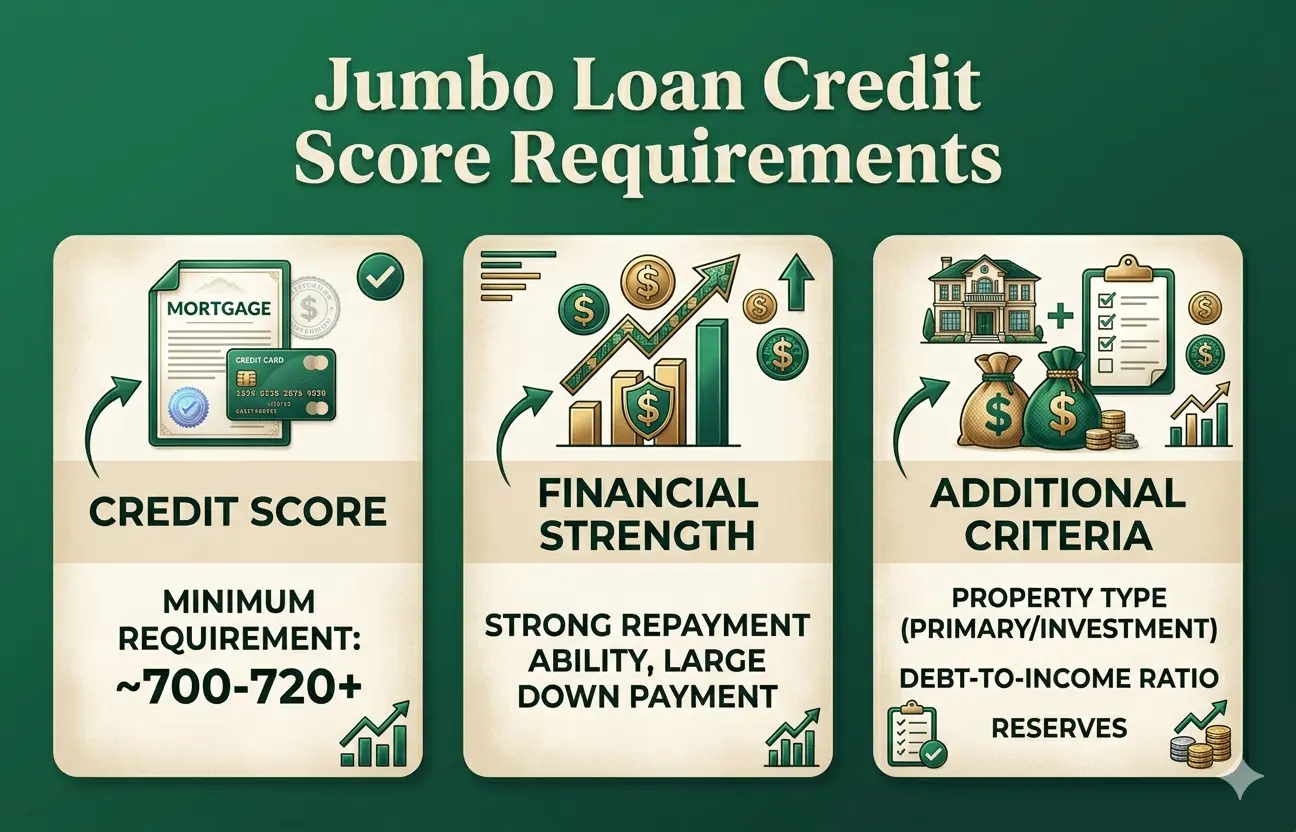
Credit score. Most jumbo lenders prefer a score of at least 700, and the strongest pricing typically goes to borrowers above 740. Some programs go lower, particularly on larger down payments. (More detail in our guide to jumbo loan credit score requirements.)
Down payment. Jumbo programs generally ask for a larger down payment than conforming loans, and requirements climb as the loan amount grows. Programs for high-net-worth and self-employed borrowers can look very different from the standard.
Cash reserves. This is the requirement that surprises people most. Jumbo lenders commonly want to see several months of mortgage payments still in the bank after closing: sometimes six months, sometimes twelve or more on larger loans. A buyer who empties their accounts for the down payment can qualify on paper and still be declined.
Debt-to-income ratio. Generally expected to be lower than on a conforming loan.
Documented, provable income. Here is where Santa Barbara files most often break down.
The self-employed problem, and the fix
Many Santa Barbara buyers are business owners, consultants, doctors, attorneys, or people with significant investment income. Those are exactly the borrowers whose tax returns can understate what they actually earn, because a good CPA’s job is to minimize taxable income and a mortgage underwriter’s job is to look at taxable income.
A W-2 employee’s qualifying income is on one line of one document. A business owner with strong revenue, healthy bank balances, and aggressive write-offs can look, on a standard conventional application, like they can’t afford a house they can obviously afford.
There are established ways around this that most retail bank loan officers rarely use:
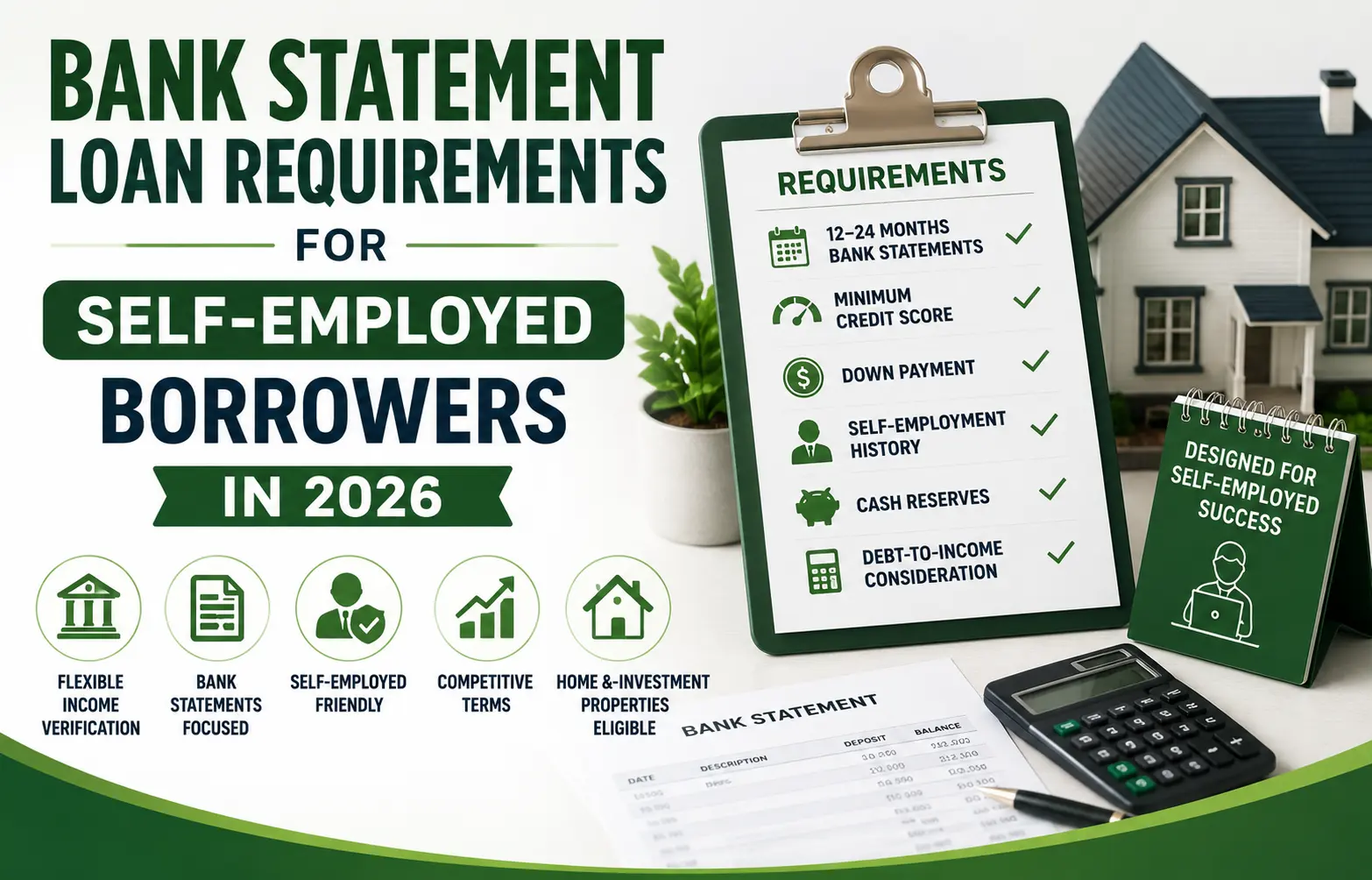
- Bank statement loans, which qualify you on 12 or 24 months of deposits instead of tax returns
- Asset depletion or asset-based qualifying, which converts a portfolio into qualifying income
- Profit-and-loss programs using a CPA-prepared statement
- Portfolio jumbo programs with manual underwriting rather than automated approval
These are not exotic or last-resort products. They are standard tools, but a loan officer at a single bank can only offer what that bank’s rate sheet contains. Through Xpert Home Lending, I have access to more than 100 lenders, so I can often place files that a single-lender shop has to decline. (See bank statement loan requirements for self-employed borrowers.)
Jumbo vs. conforming: what actually changes
| Conforming | Jumbo | |
|---|---|---|
| Loan amount (SB County, 1 unit) | Up to $941,850 | Above $941,850 |
| Guidelines set by | Fannie Mae / Freddie Mac | Individual lender or investor |
| Typical minimum credit score | Lower | Usually 700+ |
| Cash reserves required | Often minimal | Often 6 to 12 months or more |
| Underwriting | Largely automated | Frequently manual, more document review |
| Variation between lenders | Small | Large, so shopping matters |
That last row is the practical takeaway. On a conforming loan, most lenders are working from the same rulebook, so your options don’t differ much. On a jumbo loan, guidelines genuinely differ from lender to lender, which means the same borrower can be declined in one place and approved in another. Rates and terms also change daily and vary by lender, so there is no substitute for having your specific file shopped.
Before you make an offer in Santa Barbara
With a median of 42 days on market and homes selling for about 97% of list price (Redfin, August 2026), this is not a market where you can sort out financing after you’re in contract.
- Get pre-approved before you tour. Not pre-qualified: pre-approved, with documents actually reviewed.
- Know which side of $941,850 you’re on. It changes your program, your reserve requirements, and your timeline.
- If you’re self-employed, say so at the first conversation. Alternative documentation programs need to be identified up front, not discovered during underwriting.
- Ask what your reserve requirement is before you decide how much to put down.
- Get a second opinion if you’ve been declined or if a pre-approval feels shaky. It costs nothing, and a declined file is often just a misplaced file.
Frequently asked questions
What is the jumbo loan limit in Santa Barbara County for 2026?
Any single-family mortgage above $941,850 is considered a jumbo loan in Santa Barbara County in 2026. Limits are higher for 2 to 4 unit properties.
Is it harder to get a jumbo loan than a conventional loan?
Generally yes. Jumbo loans typically require higher credit scores, larger cash reserves, and more documentation, because the lender keeps the risk rather than selling the loan to Fannie Mae or Freddie Mac. But requirements vary widely between lenders, so a decline from one is not a decline from all.
How much do I need to put down on a jumbo loan in Santa Barbara?
It depends on the lender, the loan amount, and your overall profile. Jumbo programs generally require more down than conforming loans, and requirements usually increase with the loan amount. I can walk you through what applies to your situation.
Can I get a jumbo loan if I’m self-employed?
Yes. Bank statement loans, asset-based qualifying, and profit-and-loss programs are designed for exactly this situation and are widely available through brokers, though less common at retail banks.
Do jumbo loans have higher interest rates?
Not necessarily. Jumbo pricing relative to conforming pricing shifts with market conditions and varies significantly by lender, which is why shopping the loan across multiple lenders matters more on a jumbo file than on a conforming one.
Buying or refinancing in Santa Barbara?
I spent 12 years as a mortgage banker at Wells Fargo before going independent, and I now have access to more than 100 lenders through Xpert Home Lending, including ones that specialize in the files big banks turn away. If you’d like a straight answer on your options, or a second opinion on a pre-approval you already have, I’m happy to take a look.
See what you qualify for · Call 805-315-6849 · Try the mortgage calculator · Explore jumbo loan options
Loan programs, requirements, and terms vary by lender and are subject to change. Sources: 2026 loan limits from the Federal Housing Finance Agency; market data from Redfin, August 2026.