Mortgage interest rates play a big role in how much you pay for your home every month. Even a small change in the interest rate can increase or decrease your monthly mortgage payment.
Understanding how mortgage interest rates affect your monthly payment helps homebuyers plan their budget and choose the right loan.
In this guide, we explain how interest rates work and why they matter when buying a home.
What Is a Mortgage Interest Rate?
A mortgage interest rate is the percentage a lender charges for borrowing money to buy a home.
Your monthly payment includes:
- Loan principal
- Interest
- Property taxes
- Home insurance
The interest rate directly affects the total cost of your loan.
How Mortgage Interest Rates Affect Your Monthly Payment
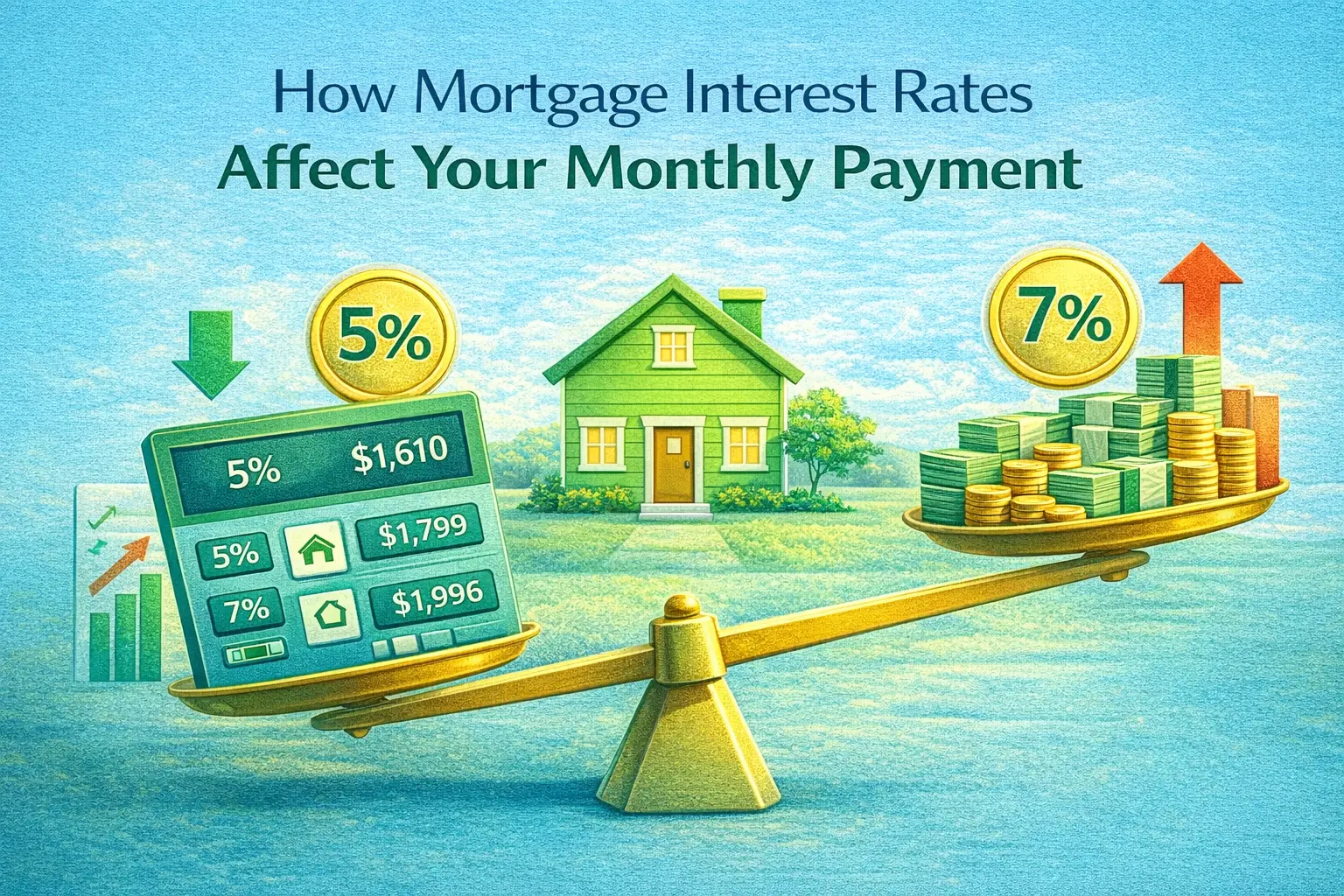
When mortgage rates increase, your monthly payment also increases.
When rates decrease, your payment becomes lower.
Here is a simple example for a $300,000 mortgage loan.
| Interest Rate | Monthly Payment |
|---|---|
| 5% | About $1,610 |
| 6% | About $1,799 |
| 7% | About $1,996 |
A 1% increase can add hundreds of dollars to your monthly mortgage payment.
Why Mortgage Interest Rates Change
Mortgage rates change based on several economic factors.
Common reasons include:
- Inflation
- Federal Reserve policies
- Housing market demand
- Economic growth
- Bond market performance
Because of these factors, mortgage rates may change daily.
Factors That Affect Your Personal Mortgage Rate
Not every borrower receives the same interest rate. Lenders look at your financial profile before setting the rate.
Important factors include:
- Credit score
- Debt-to-income ratio
- Loan type
- Down payment amount
- Loan term (15 or 30 years)
Borrowers with strong credit and stable income often receive lower rates.
Want to see what mortgage rate you qualify for?
Our team help homebuyers compare loan options and secure competitive interest rates.
Fixed vs Adjustable Mortgage Rates
There are two main types of mortgage interest rates.
Fixed-Rate Mortgage
The interest rate stays the same for the entire loan term.
Benefits:
- Stable monthly payment
- Easier budgeting
- Protection from rising interest rates
Adjustable-Rate Mortgage (ARM)
The interest rate may change after an initial fixed period.
Benefits:
- Lower starting rate
- Lower early monthly payments
However, payments can increase if rates rise.
How to Get a Lower Mortgage Interest Rate
Homebuyers can take steps to secure a better mortgage rate.
Helpful tips include:
- Improve your credit score
- Pay down existing debt
- Save for a larger down payment
- Compare multiple lenders
- Get mortgage pre-approval
Even small improvements can help you qualify for a better rate.
Ready to Buy a Home?
Our team can help you find the right mortgage with a rate that fits your budget.
Read More What Happens After Mortgage Approval
FAQs
How do mortgage interest rates affect monthly payments?
Higher interest rates increase your monthly payment, while lower rates reduce the amount you pay each month.
Do mortgage rates change daily?
Yes. Mortgage interest rates can change daily based on market conditions and economic factors.
Can I lock my mortgage interest rate?
Yes. Many lenders allow borrowers to lock their interest rate during the mortgage process to protect against rate increases.
What credit score helps get the best mortgage rates?
Borrowers with a credit score of 740 or higher often qualify for the most competitive mortgage interest rates.